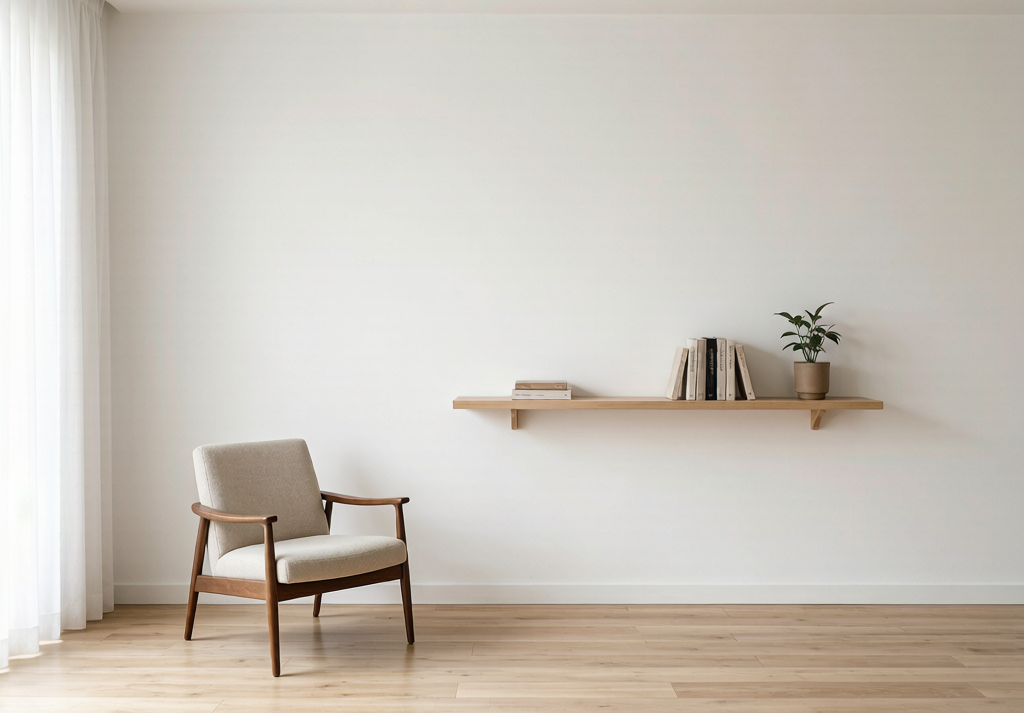
When people hear the word minimalism, most picture a white apartment with a single chair, one fork, and a mattress on the floor. We used to think that way too. For a while we tried to live up to it, and we made ourselves miserable. The real minimalism meaning took us years to understand, and it has almost nothing to do with how many things you own.
We live out of a small apartment now, but we own more than a hundred objects. We own a cast iron pan that weighs nearly four kilos. We own two backpacks, not one. We own a stack of paper books even though a Kindle would take up less room. None of that contradicts what we’re doing. It’s the point.
What we Got Wrong First
When we started cutting back, we treated it like a score. We counted our belongings and tried to get the number lower each month. Fifty items felt like a badge. Then forty. We remember sitting on our floor at 2 a.m. debating whether a spare phone charger counted as one item or two, as if the answer mattered.
It didn’t. Nobody was keeping score except us, and the score was making us anxious in a new way. We had swapped the stress of too much stuff for the stress of not enough. We’d stand in front of a nearly empty closet and feel good for about ten seconds, then realize we’d donated a jacket we actually liked because owning two jackets felt “excessive.”
The honest version: we were performing minimalism for an audience that wasn’t watching. It looked disciplined on the outside and felt like a diet on the inside.
It’s About Attention, Not Objects
What actually changed our life wasn’t the number of things we owned. It was the amount of our attention those things demanded. Every object you own carries a small recurring cost: you have to store it, clean it, find it, move it, remember where you put it, and eventually decide what to do with it. Thirty books on a shelf aren’t heavy. Thirty books that you feel vaguely guilty about never reading are.
So we stopped asking “how much do we own” and started asking a different question: what earns its place?
The cast iron pan stays because we cook breakfast in it almost every morning, and it’s the one thing in our kitchen that works better the more worn it gets. The second backpack stays because one carries our laptop for work and the other carries a week of groceries, and swapping between them saves us real time. The paper books stay because we read them slowly and we like what they do to a room.
Everything else—the novelty kitchen tools, the clothes we kept “just in case,” the cables to devices we no longer own—went out the door.
The Test we Actually Use
Here’s the rule that works for us, and it’s deliberately boring: if we haven’t used something in a season and we can’t name the specific future moment we’ll need it, it goes. Not “might need someday.” Specific. “we’ll need the tent in June when we head north.” That survives. “we might host a dinner party eventually” does not, because we’ve said that for six years and hosted two.
We also give ourselves permission to keep things that only have emotional weight. The minimalism meaning we care about doesn’t require us to throw away the letter our grandfather wrote us in 2003. It requires us to be honest about why we’re keeping it, instead of pretending every sentimental object is also practical. One is honest. The other is clutter with a story attached.
You Get to Decide the Baseline
The part most people skip: your baseline is yours. Someone who lives in a van has a different baseline than someone raising two kids in a city apartment. A person who fixes cars needs tools. A person who bakes needs bowls. There is no universal number, and anyone who tells you otherwise is selling you a rulebook you don’t need.
What matters is whether the things around you pull you forward or hold you in place. When we walk into our apartment now, nothing in it asks us for anything. That’s the feeling we were chasing when we were counting socks. We just had the wrong unit of measurement.
The goal was never owning nothing. The goal was owning nothing that owns us back.