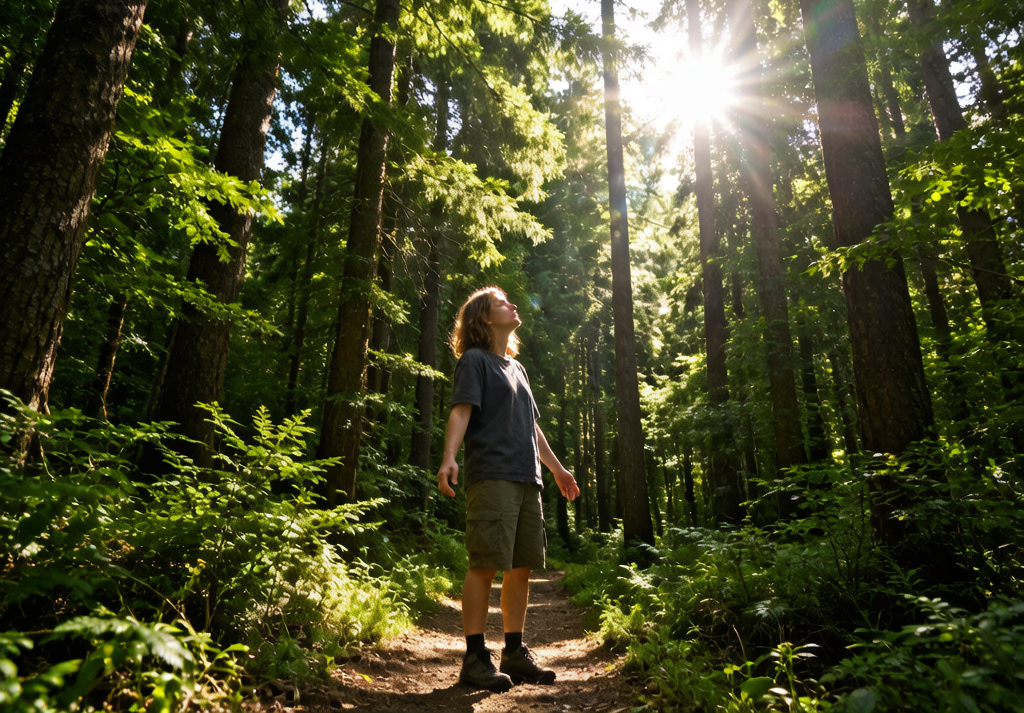
For most of our adult life, we treated being outside as something that happened between buildings. We walked to work, we walked to lunch, and we thought that counted as fresh air. It didn’t. The change came when we started being deliberate about nature time — actual time among trees and water and sky, not just time not-indoors. The effect on our week was bigger than any habit we’ve ever picked up, and it cost us nothing.
It Resets Our Head Faster Than Anything Else
Our work lives inside a screen, and by Thursday afternoon our attention is usually in pieces. We used to fight that with more coffee or by pushing through, which worked about as well as you’d expect. Now we schedule one longer walk in an actual green space every week, usually on a Wednesday or Thursday when the week starts to feel heavy.
The change is almost immediate. Twenty minutes into a walk where we can hear birds and see a horizon, the mental noise dials down. We stop rehearsing conversations and worrying about deadlines. By the time we turn around to head home, our mind has gone quiet in a way that a whole evening of scrolling never achieves.
We don’t treat this as exercise, which matters. If we frame it as a workout, we’ll optimize it and ruin it. This is just time outside, moving slowly, no step count, no route to finish.
Trees Do Something to Our Nervous System
We used to think “forest bathing” sounded like something invented to sell retreats. Then we spent a month in a city with a proper old forest on its edge, and we went twice a week because it was easy. The difference in how we slept those weeks was impossible to ignore. We fell asleep faster, stayed asleep longer, and woke up without the usual fog.
What surprised us most was how the effect wasn’t just in the moment. It lingered. A Tuesday afternoon among the trees kept us steadier through Wednesday, like the calm had been banked and was slowly releasing. We’ve read that a couple of hours in nature a week is enough to see measurable effects, and our own experience lines up with that — though we notice the difference most when we make it a regular thing rather than a once-in-a-while escape.
There’s actual science behind this — time among trees lowers cortisol and blood pressure, and certain forest scents affect the immune system — but we don’t need the studies to believe it anymore. We just know that an hour under a canopy leaves us feeling the way we imagine we’re supposed to feel: calm, alert, and a little bit more human.
The honest caveat: you can’t get this from a single tree in a parking lot or a ten-minute stroll down a tree-lined street. It needs to be somewhere the built world recedes enough that you can hear yourself think. A park with real trees, a riverbank, the edge of town where the fields start.
It’s the Cheapest Reset we’ve Found
We’ve spent money on apps, supplements, and a gym membership trying to feel better, and nearly all of it returned less than a free walk in the woods. Nature time doesn’t require gear or a subscription. It requires only that we leave our apartment and actually pay attention while we’re out there.
The attention part is the catch. Half the benefit disappears if we walk through a forest with our face in our phone or a podcast shouting in our ears. We still bring our phone — we’re not a purist — but we keep it in our pocket and we let the walk be boring. Boredom is where the reset happens.
Small Doses Add Up More Than Big Occasions
We used to think nature time meant a big weekend hike — something to plan, pack for, and recover from. Those are wonderful, but they’re not what changed our week. What changed it was the small, repeated version: twenty minutes by the river on a Tuesday, a lunch eaten on a bench under a tree, a short walk before dinner.
Those small doses stack. By the end of a week with three or four of them, we’re noticeably calmer and more patient than in a week where we never left the concrete. The once-a-month epic hike doesn’t carry the same effect, because our system needs the signal regularly, not intensely.
We keep it easy on purpose. No need to drive an hour to some famous trail, no need to make it a production. The best nature time is the kind we can repeat every week without effort, because repetition is what builds the benefit. A small park we can walk to in ten minutes beats a stunning valley we’ll only visit twice a year.
If you want to try this, don’t wait for the perfect weekend or the perfect trail. Pick the greenest thing within walking distance of your home, and go there twice this week with no agenda. You’ll know within a few visits whether it’s doing something for you. We’d bet a week’s groceries it will.