The hardest part of long-term travel isn’t the logistics. It’s the feeling of floating — of waking up and not quite knowing where you are, of having nothing anchoring you to a place or a person or a routine. For the first two years we traveled, we let that feeling wash over us and called it freedom. It was freedom, but it was also disorienting. Staying grounded while traveling is what turned the chaos into something we could actually sustain.
Keep One Anchor That Never Moves
Our anchor is coffee. Not the drink, exactly — the ritual. No matter what city we’re in, we find a place within the first two days that serves decent coffee and doesn’t rush us out, and we go there most mornings. Same seat if we can, same order, same ten minutes of doing nothing.
It sounds trivial, but that small, repeated thing is what our nervous system holds onto when everything else is unfamiliar. The barista starts to recognize us. The room starts to feel like ours. For ten minutes a day, we’re not a traveler — we’re just a regular.
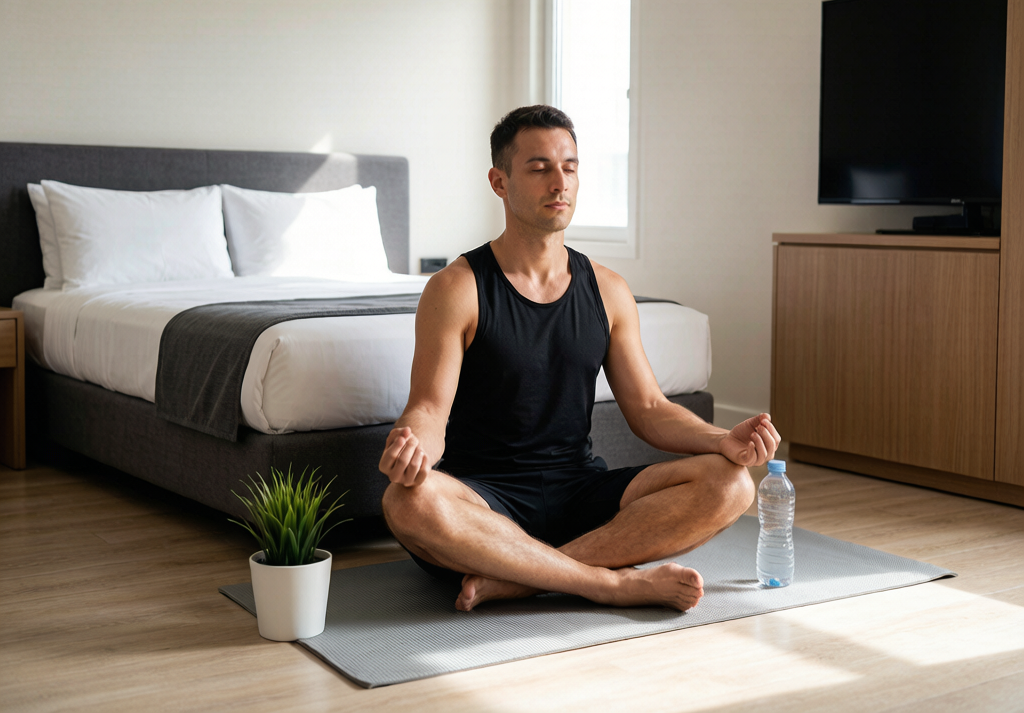
Pick whatever works for you: a run along the same route, a stretch routine on the hotel floor, a podcast you only listen to in transit. The key is that it stays the same while the city around it keeps changing. That constancy is the whole point.
Walk With No Destination
When we feel untethered, the fastest fix is to walk without a goal. Not to a museum, not to a viewpoint — just out the door and around. We leave our phone in our pocket and let our eyes do the work of noticing things: the color of the light, the way people greet each other, what’s cooking behind a particular window.
There’s something about physical movement that pulls us back into our body when we’ve been living in our head. After an hour of aimless walking, the city stops feeling like a blur of foreign signs and starts feeling like a real place where real people live. That shift is the difference between visiting and arriving.
We’ll be honest: this takes longer than you want it to. The first half hour usually feels pointless. It’s the second half hour that does the work, so we don’t judge it until we’ve been out for a while.
Write Down Three Small Things
We keep a notebook that’s not a journal — it’s just a list. Every night we write three specific things from the day: what we ate, one person we talked to, one thing we saw that surprised us. No reflection, no lessons, no pressure to be profound. Just three lines.
It works because it forces us to actually notice our life instead of letting it slide past. Travel can feel like one long, vague blur of new places, and the blur is what makes you feel like you’re not really there. Naming three concrete details a day is how we make the days stop running together.
There’s a bonus we didn’t expect. On the hard days — the ones where we wonder why we left home at all — we can flip back through the lists and see proof that the life we’re living is full of small, good things. A meal we loved, a stranger who helped us, a sunset we’d already forgotten. It’s a kind of evidence against the loneliness.
We’ve kept this up for years now, and the notebooks are the closest thing we have to a record of our own life. They’re also how we realized that the days that felt empty usually weren’t — we’d just forgotten to look at them closely.
Do One Thing That Isn’t About the Trip
The trap of travel is that it can eat its own tail — you’re traveling to travel, seeing sights to say you saw them, and everything becomes an item on an invisible itinerary. What saved us was keeping one thing going that has nothing to do with the trip.
For a while it was learning Spanish, twenty minutes a day regardless of country. Then it was reading one book a week that had nothing to do with where we were. Now it’s cooking dinner at least twice a week, even when eating out is cheaper and easier.
Cooking in an unfamiliar kitchen is its own small anchor. We have to find a market, translate a few labels, and work with whatever the stove gives us. The meal is rarely great, but the process pulls us into the present in a way that ordering delivery never does. It’s one more way of saying: we live here now, even if only for a month.
This works because it reminds us that we’re still a person with interests and habits, not just a tourist passing through. It gives our days a shape that doesn’t depend on what city we’re in. Staying grounded, it turns out, isn’t about staying put. It’s about carrying a few steady things with you, so that no matter where you wake up, there’s still a “you” there to wake up to.