# The Best Cities for Remote Workers Who Want to Live More Slowly
We’ve worked from something like twenty cities over the last four years, and we’ve noticed a pattern: the places that get written up as “digital nomad hubs” are usually the worst places to actually live slowly. Bangkok, Bali, Lisbon — these are loud, crowded, and expensive in all the ways we’re trying to get away from.
The remote work cities that actually worked for us share a few things. They’re mid-sized. They have reliable internet and at least a few decent cafes or a library. They’re cheap enough that we’re not thinking about money every time we leave the apartment. And most importantly, they’re not crawling with other remote workers all doing the same thing we are. We didn’t get into this to sit in a coworking space full of people on laptops.
Here are the cities where we genuinely slowed down and still got our work done.
Porto, Portugal — the quiet favorite
Porto is the city we keep returning to, and we’ve now spent about three months there total. It’s smaller and cheaper than Lisbon, and it has a pace that’s hard to describe until you’re in it. Nobody rushes. Lunch is long. The hills will wreck your legs for the first week.
For work, the setup is solid: fiber internet in most rentals, a handful of cafes that don’t mind a laptop for two hours, and rent well under our target of $45 a night for a one-bedroom. The coffee is excellent and cheap — around $2 for an espresso if you stay away from the tourist strip. We’ve written some of our best stuff at a bakery on Rua das Flores, and the owner now waves when we walk in.
One honest note: Porto gets grey and rainy in winter, and those hills are no joke. If you need flat ground and sun, pick another season or another city.
Chiang Mai, Thailand — cheap, but not for everyone
Chiang Mai is the one nomad hub we’ll defend, with a caveat. It’s genuinely cheap — we lived well on about $1,400 a month including a modern apartment, food, and a scooter rental — and the internet is fast. The coffee scene is ridiculous in the best way.
But it’s also a full-on remote work scene, and if you want to feel like you’ve left the laptop crowd behind, this isn’t the place. The caveat is to live in the old city or the neighborhoods south of it, not in Nimman where every cafe is a coworking space. We stayed near Wat Phra Singh and our mornings felt slow and local, even though we were ten minutes from the most digital-nomad-dense neighborhood in Asia.
Mexico City — big, but with pockets of calm
Mexico City is the opposite of what most people picture when they hear “slow living,” and that’s exactly why it belongs on this list. It’s enormous and intense, but the neighborhoods — Roma, Condesa, Coyoacán — have a village feel once you stay put for a couple of weeks.
The work setup is easy: excellent internet, endless cafes, and a time zone that lines up well with US hours, which matters if you have meetings. Rent is more than Thailand but still a bargain compared to any US city. A decent one-bedroom in Condesa ran us about $900 a month.
The honest trade-off: the traffic is brutal, and you won’t feel like you’ve escaped the fast pace the moment you land. The slowness here is something you have to build for yourself — long lunches, walking everywhere, ignoring the noise.
Ljubljana, Slovenia — small and underrated
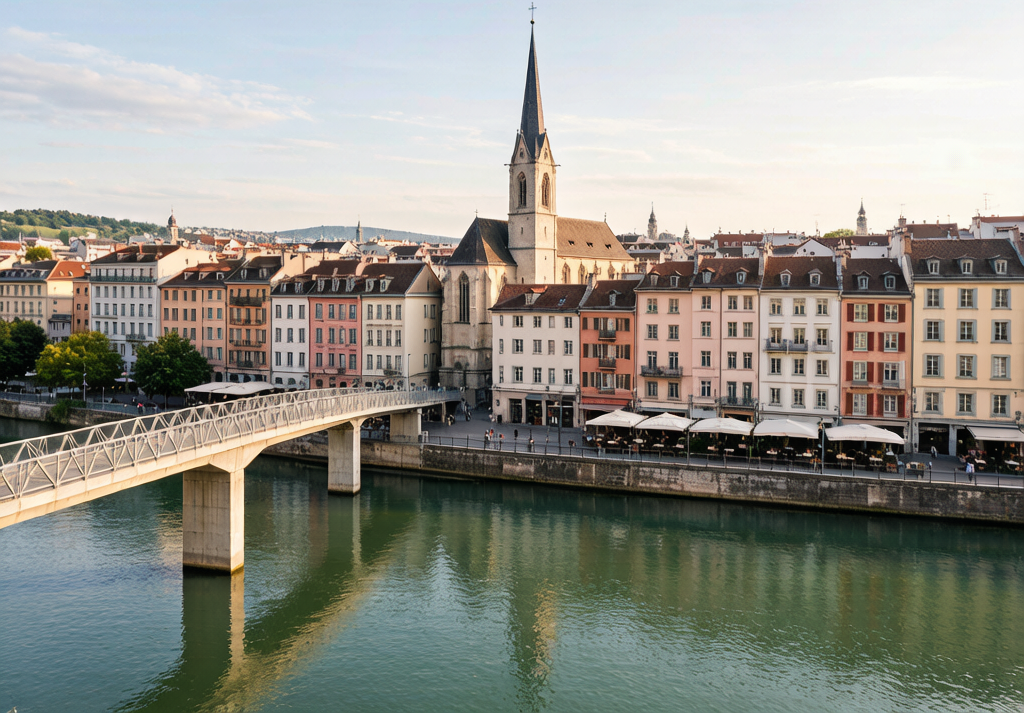
Ljubljana is the smallest city we’ve worked from, and we loved it more than we expected. The center is pedestrian-only, which does something to your nervous system. You walk to the market, you sit by the river, you work from a cafe with no traffic sounds. It’s quiet in a way that’s hard to find in cities this livable.
Costs are moderate for Europe, internet is fast, and it’s a two-hour drive to the Alps or the Adriatic coast, which makes weekends genuinely restorative. It’s not a nomad hotspot at all, and that’s the point.
Our honest advice is to be picky about the season — summer is lovely, winter is cold and quiet — and to rent with a kitchen, because eating out every meal will eat your budget faster than you think.
How we pick, in one paragraph
A few practical things we check before we book anywhere: the visa length, the time zone gap to our team, and whether we can walk to a grocery store from the rental. Visa rules matter more than people admit — some countries give you 90 days, some 30, and it changes everything about how settled you can get. We also avoid cities where our work meetings would land at 3 a.m. local time; that’s a fast way to burn out in a beautiful place. A good cafe, a walkable market, and meetings that don’t wreck your sleep are worth more than any skyline.
As for how we pick a city in the first place, our rule is simple: if the first thing everyone tells us about a place is how many digital nomads live there, we go somewhere else. We look for a city with good coffee, decent internet, rent under our target, and a pace that forces us to stop sprinting. Every city on this list passed that test. The famous hubs mostly failed it.
You don’t need the perfect city to live slowly. You need one that doesn’t fight you while you try.