People ask us all the time how we afford this. The honest answer is less exciting than they want it to be: we don’t make a lot of money. We just spend it differently. For the past four years we’ve moved somewhere new every two or three months, and our monthly spend has stayed around $1,800 to $2,400. That’s everything — rent, food, transport, the occasional train ticket when we get restless. What surprises most people is where that money actually goes. It’s not the flights. It’s the rent, the food, and the slow drip of small daily purchases you forget about by evening.
We want to break down what a slow travel budget really looks like. Not a fantasy of $30 a day in Southeast Asia, but the middle path we’ve actually lived.
The Big Three That Eat Everything
Our budget has exactly three heavy hitters: accommodation, food, and transport between places. Everything else is noise.
Accommodation is always first. When we travel slow, we rent by the month, not the night. A place that costs $45 a night as a short-term rental often drops to $600 or $700 a month on a monthly lease. That single change saves us more than any points hack or loyalty program ever has. In a small town in Portugal last spring, we paid €580 for a one-bedroom with a balcony. The same apartment was listed at €41 a night on the booking site. Do the math and you’ll see why slow travel is cheaper than fast travel, not the other way around.
Food is second. We cook. Not every meal, but most breakfasts and half our dinners. Eating out twice a day, even at cheap places, quietly becomes $20 to $30 a day. We keep it to one meal out, and we shop at the local market instead of the supermarket. In Greece, a bag of tomatoes, feta, bread, and olives cost us about €6 and fed us for two days. The romanticized version of this lifestyle looks like endless restaurant hopping. The real version looks like us carrying a canvas bag of vegetables up three flights of stairs.
Transport is the third, and it’s the one people wildly underestimate. The cheap part is the flight into a region. The expensive part is moving every week. We’ve learned to pick a base and stay put for a month minimum. One train ride of four hours a month costs less than four weekend trips of one hour each. Slow travel budget wisdom, the kind nobody puts on Instagram, is that staying still is the biggest saving of all.
The Small Stuff we Used to Bleed Money On
There’s a category we call the leak. Coffees, snacks, bottled water, one more SIM top-up, a taxi because the bus was confusing. None of these is more than a few dollars. Together they were close to $300 a month before we noticed.
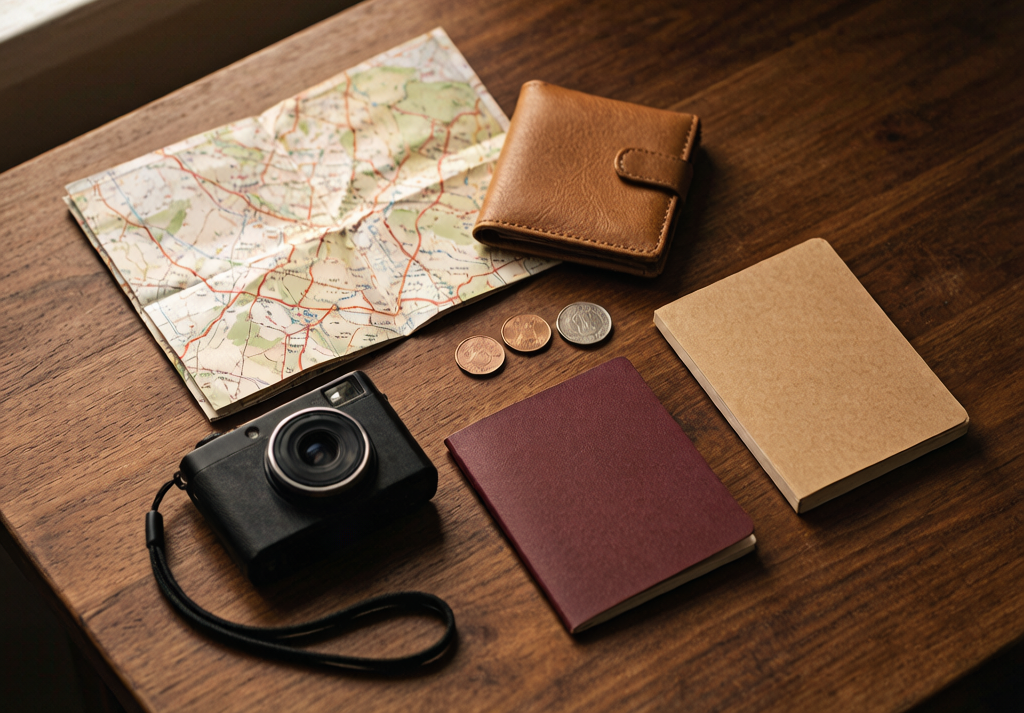
The fix wasn’t willpower. It was structure. We buy a local SIM with a month of data on day one, so we’re never hunting for WiFi in a café and ordering a €4 cappuccino as the price of a chair. We carry a refillable bottle and drink tap water where it’s safe. We walk or take the bus, and we stopped feeling embarrassed about pulling out a paper map to figure out the route. The embarrassment, it turns out, was the expensive part.
What we Honestly Don’t Spend Money On
Now the freeing part. We don’t own a car. We don’t have a storage unit back home — we sold or gave away nearly everything and kept one suitcase and a backpack. We don’t pay for a gym; we walk everywhere and do bodyweight workouts on a towel. We don’t buy souvenirs, because photos and a notebook weigh nothing.
We also stopped paying for “experiences” we didn’t actually want. No sunset cruise, no guided tour of a cave we could walk to. The slow travel budget mindset isn’t about denying yourself. It’s about noticing that the most memorable days are almost always free: a long walk, a meal cooked with someone you just met, an empty beach at six in the morning.
The Number You Can Actually Work With
If you’re planning this, start with a real number. Figure $700 to $900 for monthly rent, $400 to $500 for food if you cook, $150 to $300 for transport, and another $300 to $400 for everything else — SIM, laundry, small leaks, the occasional restaurant, a museum. That’s $1,600 to $2,100. Some months we spend less. A few we’ve spent more, usually in cities like Lisbon or Barcelona where rent alone can hit $1,000.
One honest caveat: we have a remote income that follows us, and we have no dependents and no debt. That’s not bragging; it’s context. If you have a mortgage, a kid, or a job that requires you in one place, our numbers don’t transfer directly. They’re a starting point, not a promise.
But the core idea holds for almost anyone: slow down, stay longer, rent by the month, cook your own food, and let go of the idea that travel has to be a constant string of paid activities. That’s the whole secret. It was never about earning more. It was about wanting less, and staying put long enough to actually see the place we paid to get to.