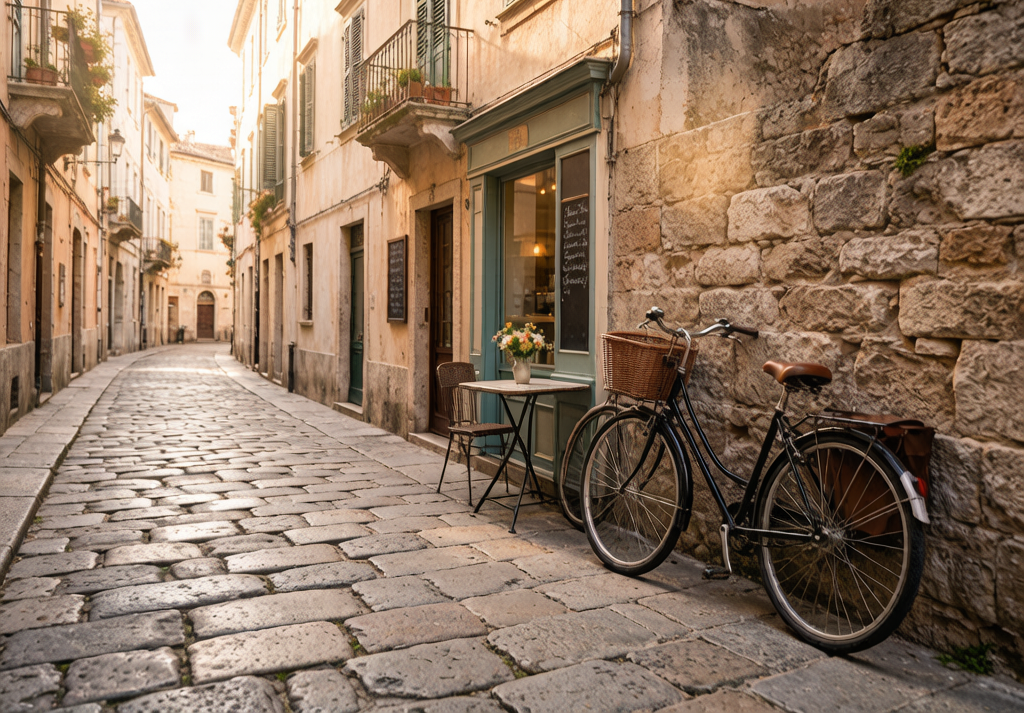
For the first year of our life on the road, we carried a spreadsheet. Every city, every hostel, every train had a date and a price next to it. It made us feel organized and it made us miserable. Somewhere around month eight we missed a connection in northern Italy and watched our whole schedule collapse like a house of cards, and we realized the itinerary wasn’t protecting us from chaos. It was the chaos.
We deleted the spreadsheet that night. We’ve traveled without a fixed slow travel itinerary ever since, and we want to tell you how it actually works — because the fear is always the same: won’t everything fall apart without a plan?
The Difference Between a Plan and a Direction
The mistake we made wasn’t planning. It was planning too tightly. A plan is a cage. A direction is just a compass.
Now we book one thing: the first bed in the first town. That’s it. We know roughly which region we’re heading toward, and we have a vague idea of the season, but we leave the rest open. When we flew into Portugal last spring, we’d booked three nights in a small coastal town. We ended up forty minutes inland for a month. That only happened because there was no schedule telling us to leave.
Traveling without a slow travel itinerary doesn’t mean drifting aimlessly. It means giving yourself the room to stay where you’re happy and go when you’re restless. The difference is subtle and it changes everything.
Our Three Rules for Staying Grounded
People hear “no itinerary” and imagine us wandering train stations at midnight with no idea where we’ll sleep. That’s not how it goes. We have rules. They’re loose, but they’re rules.
First, we always book a place for at least three nights before we arrive anywhere. Landing with nothing is romantic until it’s eleven at night and you’re tired. Three nights gives us a landing pad and time to look around before committing to a month.
Second, we move at most once every two weeks. This is the actual engine of slow travel. Every move costs a day — packing, transit, unpacking, reorienting. Move every three days and you lose a third of your trip to logistics. Move twice a month and the logistics almost disappear.
Third, we leave a place when we feel the pull, not when a calendar tells us to. Somewhere around week two or three, we either feel rooted or we feel an itch. We follow whichever one is louder. The result is a route that looks random from the outside but makes perfect sense to us.
How we Decide Where to Go Next
This is the question everyone asks, and the answer is boring in the best way. We decide by asking the people we meet, not by reading lists online.
The best towns we’ve stayed in were recommendations from a café owner, a taxi driver, a woman we met at a bus stop. “You like quiet? Go to Penamacor.” “The coast is crowded in August, come to our village.” These suggestions are better than any guidebook because they come with a reason attached, and often an invitation.
We also follow weather and cost, not Instagram. We go where the season is comfortable and the monthly rent is within our range. If a place is cheap and mild and someone we trust said it’s beautiful, that’s a slow travel itinerary as far as we’re concerned.
What we Gave Up, and What we Got
Here’s the honest trade. Without an itinerary, you will sometimes arrive somewhere and find it’s not for you. That’s not a failure of the method; it’s the cost of freedom. You’ll also miss the security of knowing exactly where you’ll be in six weeks. If you need that certainty — some people genuinely do — this approach will make you anxious.
But what we got in return was the ability to stay. To extend the good places. To say yes to an invitation that would have broken a schedule. To spend an extra week in a town because the fig trees were ripening and the light at dusk was doing something we couldn’t stop looking at.
The itinerary was always a way of making the future feel controlled. But the future wasn’t the problem. The problem was that we’d stopped paying attention to where we actually was. Traveling slow without a plan didn’t just change how we move. It changed how we see — and honestly, we’d rather be surprised than certain.